
Flames kicked from NHL quarter finals, Oilers move on

3–5 minutes

The Edmonton Oilers have eliminated the Calgary Flames, winning Game Five in overtime to secure the team’s first trip to the NHL Western Conference final since 2006.

Analytically the Flames kept the series tight, often surpassing the Oilers in key statistics. Coach Daryl Sutter is known for defensively responsible 5-5 hockey, and that is exactly what the Flames produced. They led the Oilers in face-offs won, they out-shot the Oilers, they out-hit the Oilers, and the quality of their shots mostly matched that of their opponent’s.
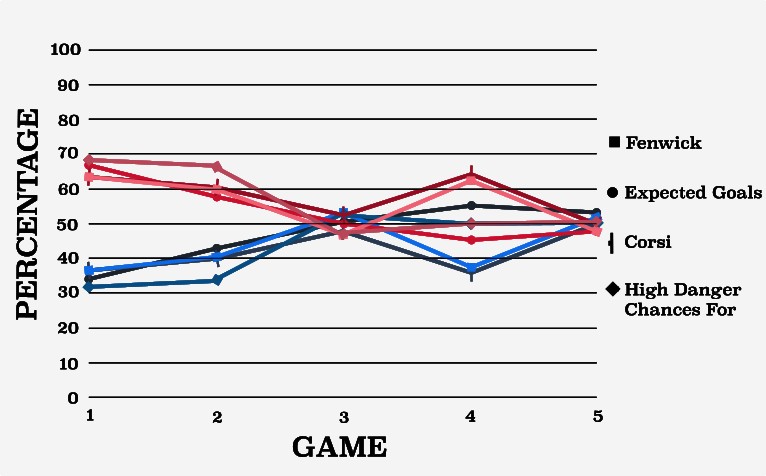
A line graph depicting shot quality over the five game playoff series between the Calgary Flames (in red) and the Edmonton Oilers (blue). Fenwick, Expected goals, Corsi, and High Danger Chances For are advanced hockey stats that measure the likelihood a shot has of being a goal.

The difference came down to two players, arguably the most important members of their respective teams — Connor McDavid for Edmonton, and Jacob Markström for the Flames.

There were signs of things to come starting in the first game of the series, overshadowed by an eclectic game the Flames won 9-6. While Oilers coach Jay Woodcroft elected to yank goaltender Mike Smith out of his net six minutes into the first period, Sutter let Markström suffer six goals on 28 shots against in the eventual win.

Oilers forward Zack Hyman scored twice on Markström’s glove side, and the team would continue to target that weakness. The Oilers scored four glove-side goals in Game One, two in Game Two, two in Game Three, and three more in Game Five. Markström finished the series with a .850 save percentage, compared to Smith’s .907.

Connor McDavid, captain of the Oilers and league-leader in total points, also foreshadowed his imminent dominance with a skillful deke to open the scoring for Edmonton. He finished the series with 12 points, evidently scoring at will.

His series winning overtime goal was a shot from the slot through Markström’s glove.

Flames fans had a fairly stressful post-season, all things considered. In the first round they faced the Dallas Stars and notably goaltender Jake Oettinger. Over the course of the series, Oettinger made 268 saves — the third highest total ever during a playoff series.

Some frustrated fans went as far as to conduct Amharic curses in an attempt to get an edge over the net-minder.

At the tail-end of that series, Flames officials also elected to make tickets mandatory to attend the Red Lot event, a viewing party held outside of the Scotiabank Saddledome. Tickets for Game One of the Battle of Alberta became available at 9:00 a.m., May 18.

By 9:03 a.m., they were all gone.

“[There was] nothing. Sold out, like a big name concert,” said Takumi Matsuura, a local Flames fan.

“I was shocked.”

Matsuura is originally from Japan, and moved to Calgary to work as an automotive mechanic. According to him, he became interested in hockey when a friend brought him to a Flames game.

“I have a soccer team in my hometown, but I love [the] Flames more than them”, said Matsuura.

The event would eventually be cancelled due to high winds which caused significant damage to the area, and the Flames media team announced they were cancelling the following two Red Lot events.

They re-opened the event for game 4, and again, all 5000 available tickets were claimed nearly immediately.

Arthur Gallant was one of the fans who managed to get a ticket.

“This is a hockey city. It’s so exciting to be able to have a team that does well [and] we can all get behind it,” said Gallant.

“More importantly, after the pandemic — I don’t like crowds, but I love the sense of community.”

Another heartache for Flames fans came in the third period of the final game of the series. In a situation oh-so reminiscent of the 2004 Calgary-Tampa Bay final, the Flames were the victims of a controversial call when Blake Coleman had a goal disallowed due to a “distinct kicking motion”.

“When you look at it from above, the angle definitely changes like quite a lot,” says Kim Michelle-Brown, an Oilers fan and St-Albert resident.

“Whether I could say it was a full kicking motion? I don’t know.”

The call will be sure to sow discourse in many Alberta homes for decades to come.

While the end result was no doubt disappointing, Flames fan can take solace in a team that far exceeded expectations from the beginning of the regular season.

“Keep your chin up and your chests out and walk out proud,” said Sutter in his post-game press conference.

“Did a hell of a lot more than anybody said they’d do. I mean, the team that beat us was a favourite coming into the year and we weren’t even close.”


Calgary Flames fans look on from the Red Lot viewing party in Calgary as the Edmonton Oilers open the scoring.

Calgary to reconnect Inglewood Bird Sanctuary with Bow River

2–3 minutes
The site of the new Bow River channel inlet.

The city of Calgary is spending $6.7 million on the Inglewood Bird Sanctuary (IBS) reconnection project, citing the need to replace outdated infrastructure and to improve water quality within the lagoon.

The IBS, initially founded in 1929 by Selby Walker, is an abode for both city-dwelling and migratory birds — as well as other assorted wildlife. Since its inception, 270 species of birds and 21 species of mammals have been recorded in the urban park, according to the city.

The project will have three stages; stage one having begun in late March of this year. This first stage consists of digging out an inlet from the Bow River into the sanctuary, as well as reshaping gravel bars affected by the 2013 floods.

The city also plans to use bioengineering techniques to combat the erosion of the sanctuary’s river banks, using natural materials to create a self-sufficient system once properly established.

“[Bioengineering is] a technique that we’ve been using in the last nine years since the flood, in terms of including willows and plants and vegetation mixed in with rock and other material to stabilize the slopes,” says René Letourneau, a senior project engineer for the city of Calgary’s Water Resources and Infrastructure Delivery team.

“Over time the plants, the roots, [they] literally bind to either the rock or whatever material and actually get stronger over time.”

Stage one is currently on track to be completed in September, but as the construction is being done within a bird sanctuary, it will ultimately depend on the behaviour of the incumbent wildlife.

“Once the nesting season is over, which we expect to be late August, we will . . . resume some of that work where we can,” said Letourneau, “September is probably a good estimate that the IBS channel is complete or near complete”.

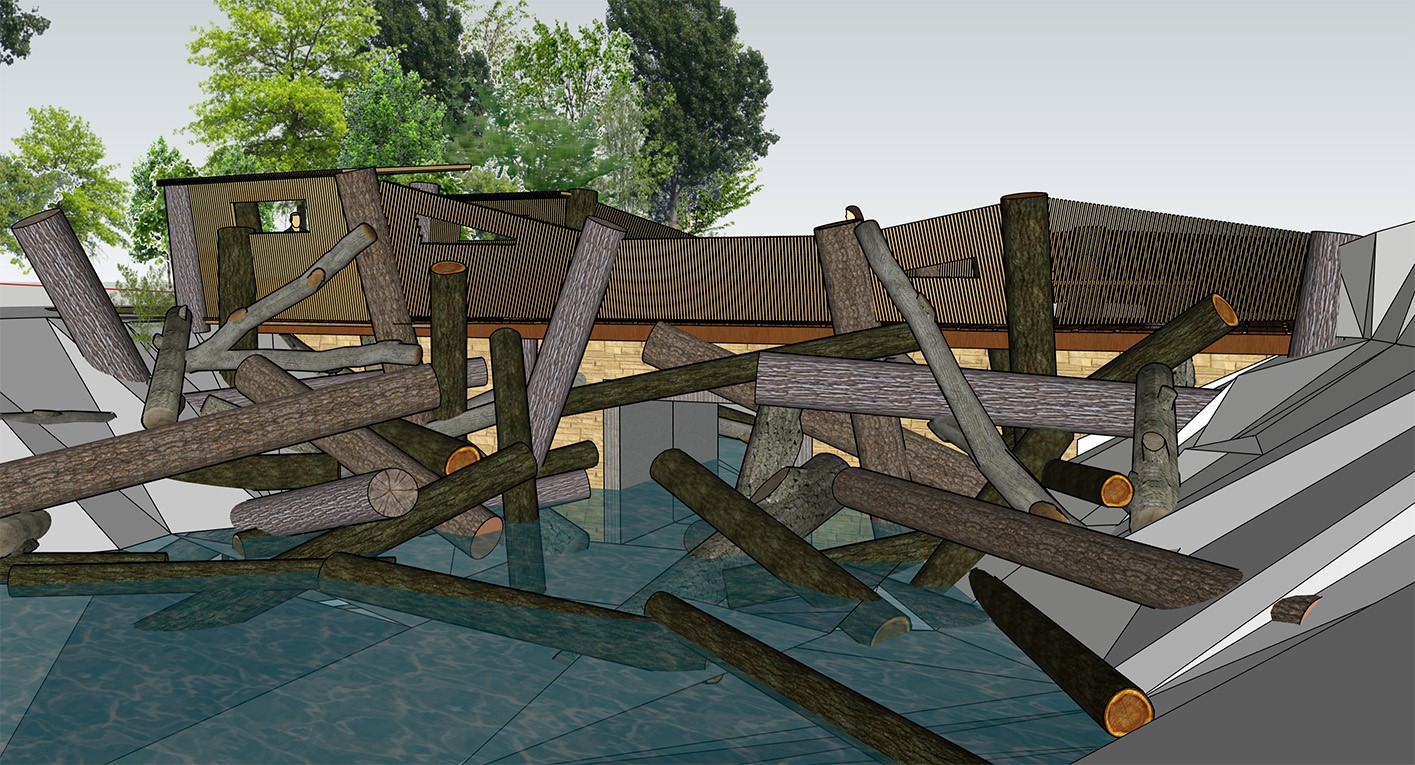
Stage two will see the installation of an art piece that doubles as a bridge over the newly constructed channel, the so-called “log jam” display designed by artist Tim Knowles.

Stage three will involve the replacement of the sanctuary’s hydraulic outlets, which were built over 100 years ago. These outlets will facilitate travel through the pond and eliminate fish traps and will also be used to control water levels within the lagoon.

“The project will also reduce the risk of the Bow river diverting to the sanctuary,” said Letourneau, “which if that were to happen it could harm the park; it could damage the Colonel Walker house and the lagoon itself.”

The full project is slated to be completed by September 2024, after which it will undergo a five-year monitoring period. The city expects the IBS to be fully operational during that time, although parts will remain fenced off to promote the establishment of vegetation and to protect the nesting sites of birds.

Centre for Suicide Prevention providing materials, training to Alberta pharmacies

2–3 minutes

The Centre for Suicide Prevention (CSP), a Calgary based organization with a focus in education, is now providing materials and START training to pharmacies in Alberta that request it.

According to the centre, pharmacists and their staff have the potential to play a crucial role in recognizing customers as suicidal, as well as how to approach them and how to assist them.

Akash Asif, the director of external relations for the CSP, spoke about how one of these interactions could look like.

“[It could be] someone is standing in front of the aisle and looking at a bottle of Tylenol, or other drugs there, and they don’t look like themselves — they look a little bit different or there’s some nervousness,” said Asif.

“[We want to] prepare people and equip them with the understanding of skills to be able to go and see and talk to them, let them know that [they’re] there for them.”

One of the CSP’s tools in achieving this goal is START training, an online training course provided by LivingWorks.

The course can be completed in less than two hours and focuses on recognizing when someone is thinking about suicide and connecting them to help and support.

“The first thing is understanding that anyone can be going through suicidal thoughts, or that anyone can consider suicide,” said Asif.

“It’s [about] recognizing the warning signs and mutations; knowing and paying attention to the people around you and understanding that there’s something different about them.”

Asif said these signs can present themselves in a variety of different manners, such as sporadic swings in mood or behaviour.

“START is really around paying attention, having [the] conversation, and then connecting that individual to the proper resources.”

Tasha Porttin, pharmacist and store manager of the Jasper Mettra Pharmacy, is one of the first participants of the CSP initiative.

Porttin says she first heard of the START training through the CSP and that most of her staff have completed the training.

“It’s great for people that aren’t necessarily healthcare workers . . . to have kind of a bit of basis around suicide prevention and knowledge on how to start that conversation with individuals”, said Porttin, “and just how to ask questions that maybe we’re not used to asking or maybe not comfortable with asking.”

Porttin also requested suicide prevention materials from the CSP, which now adorn her pharmacy.

The materials provided include assorted signage, pop-out shelf talkers, and take-away cards.

“Some people have expressed that that’s really refreshing to see,” said Porttin, “[and the staff are] really kind of grateful that it is up in the store [because] it just gives people the opportunity to know that this is a safe place.”

“I even had somebody, to be honest they were quite teary eyed, when they were thanking me for putting it up,” said Porttin.

“You could tell that that was a very touching thing for them to see.”

To those experiencing suicidal thoughts, the CSP recommends contacting Calgary’s Distress Centre. The centre has a 24-hour crisis phone line, and also provides counselling to those in need.

Okotoks receives FCM investment in order to boost asset management

2–3 minutes

The town of Okotoks will be receiving $49,680 from the Federation of Canadian Municipalities (FCM) in an effort to improve asset management capabilities. 

The town hopes to use this investment to integrate its Tangible Capital Asset data with its Geographic Information System (GIS).

Tangible Capital Assets are the significant economic resources managed by a community — such as road infrastructure, water management, and utility systems. GIS maps are used to help observe patterns and relationships, and to provide geological context.

 By merging the two, asset managers like Mark Styranka, a specialist hired by the town of Okotoks in 2018, can approach the data much more efficiently. 

“The goal is to formalize the process among all the assets in the town where we know the condition of all the assets possible,” said Styranka, and that that will help the town create “a magical formula to help decide [our] priorities”.

What Styranka hopes to do, in the simplest of terms, is to match up individual asset identifiers with the town’s available GIS maps. With over 30,000 individual assets available, that is no small task.

Styranka himself applied for the funding, and he said the town hopes to use that money to acquire an additional staff member.

“Roads are the big one left to do. If we did it ourselves it would take maybe two years,” said Styranka, “[now] we’ll hopefully have it done by the end of the year.”

Okotoks is one of 37 Alberta communities receiving an investment from the FCM in order to bolster asset management. Founded in 1901, the advocacy group receives funding from the federal government and in turn allocates it to municipalities across Canada.

“[Communities in Canada are] working to enhance their infrastructure and natural assets so they can continue to have sustainable and reliable services to improve residents’ quality of life,” said FCM president Joanne Vanderheyden in a February press release.

“Ensuring local governments have the right tools to make sound asset management decisions is one way we can help drive Canada’s economic recovery.”

Okotoks and the FCM have a long-standing relationship. In 2001, the town received support from the FCM’s Green Municipal Fund (GMF) in order to revamp its wastewater treatment facility by equipping it with a composting system. 

The result of this program was a 46 per cent reduction in gross per capita water consumption, and an estimated $63 million saved in water license purchases. In 2015, the project received an FCM Sustainable Communities award for the associated case study.

Okotoks again received this award in 2018 for its Living Soils filtration project, a bioretention stormwater management system. 

These initiatives are just two of the 120 GMF funded projects completed in Alberta thus far.

“I think sometimes Albertans get a bit of a rough ride because of being centered around oil,” said Styranka.

“Most people, especially in rural areas, are positive stewards of the land.”

Avalanche professionals seek to raise awareness among Alberta snowmobilers

2–3 minutes

As more Albertans continue to venture into the province’s avalanche terrain each year, organizations like Avalanche Canada are faced with the increasing task of keeping recreationalists safe – whether they travel on foot, skis, or motor vehicle.

While there were no Alberta snowmobile fatalities in avalanche terrain in 2021, snowmobilers and snow bikers did account for six of the twelve fatalities nationwide; and since 2012, 42 of Canada’s 104 avalanche fatalities have occurred on snowmobiles. Snowmobilers are generally at more risk due to their ability to travel long distances over varying avalanche terrain, as well as the fact that snowmobiles deliver approximately five times more energy to a snowpack than a skier.

“We meet with [snowmobilers] to find out what’s going on in the snowmobile industry,” said Alex Cooper, a communications associate for Avalanche Canada, “[and to find out] where we can apply our efforts to make sure that we’re reaching out and getting snowmobilers trained.”

Avalanche Canada utilizes several programs to target snowmobilers specifically, and according to their 2021 annual report, “make significant efforts to make and maintain connections throughout Western Canada, with a specific emphasis on reaching riders in Alberta and Saskatchewan.”

Avalanche Canada launched a dedicated snowmobile outreach program in 2011 and introduced a snowmobile mentorship program in 2020. They also collaborate with groups such as the Alberta Snowmobile Association (ASA) to provide information and training guidelines.

Courses are provided by Avalanche Canada and similar organizations throughout the winter season, with the most popular program being the Avalanche Skills Training (AST1) course. Out of the 15,029 students enrolled in courses in 2020-2021, only eight per cent were snowmobilers.

Shane Lavery, 31, has recently taken up the sport of backcountry snowmobiling after nearly ten years of ski touring.

“The safety protocols in general when it comes to snowmobilers, at least in my limited experience so far … it seems to be a lot more lax,” says Lavery.

On the differences between ski touring and snowmobiling, Lavery says it comes down to increased exposure and magnitude.

“[The] sheer amount of exposure versus a ski tourer or a snowshoer [means] you can get to ten times the amount of terrain in a fraction of the time,” said Lavery, “I think the propensity to actually cause larger events is definitely there when it comes to sledding in comparison to skiing or split-boarding.”

While avalanche awareness amongst snowmobilers remains a concern, awareness amongst all general practitioners has risen steadily throughout the years. One tool to measure this growth is the increase in Mountain Information Network (MIN) postings. MINs are a way to share avalanche observations and trip reports to both recreationists and professionals.

Since its inception in 2014, more than 13,000 reports have been uploaded to the database. Out of the 5,561 submitted MINs during the 2020-21 season, 476 were in Alberta — a 205 per cent increase from the previous year. For comparison, B.C. users logged 3,445 reports in the same time span, which was a 125 per cent increase from the previous year.

Is CWD putting Alberta’s game farms at risk?

3–4 minutes

As Chronic Wasting Disease (CWD) spreads through Alberta, one conservationist organization has announced the time is nigh for the province’s game farms.

CWD is a prion disease similar to bovine spongiform encephalopathy (BSE, or mad cow disease), except that it affects cervids rather than cattle. Like BSE and all other prion diseases, CWD has a 100 per cent fatality rate.

While the disease is being researched extensively, its potential impact is uncertain. What is certain, according to a map published in May by the United States Geological Survey (USGS), is that CWD is present in Alberta’s game farms.

In response to this USGS map, the Alberta Wilderness Association (AWA) penned an open letter to the provincial government requesting game farms be shuttered immediately, citing the fact that they help facilitate the spread of diseases like CWD into native wildlife populations.

Carolyn Campbell, a conservation specialist for the AWA, says the organization has been besieging the province to outlaw game farms since the practice was introduced in the 1980’s. 

“CWD [is] in captive facilities in Alberta, as well as in Saskatchewan [and] that really tells us a lot that this is a continued problem” says Campbell, “the chain of new infections and of supporting new infections, needs to be broken by eliminating game farms.”

According to Campbell, wild animals are curious when it comes to game farms and will often come for a closer look.  

“Body fluids that are on the ground can be eaten or even spread in the soil,” said Campbell, “and so the wildlife is vulnerable to that transmission.”

While a major worry is susceptible wildlife, there is also concern of human infection through the consumption of infected meat.

Dr. Sabine Gilch, of the University of Calgary’s Prion Disease Research department, has been conducting experiments on CWD using tissue matter attained from infected macaque monkeys.

By injecting this material cerebrally into rats, Dr. Gilch and company discovered that there was a chance of infectivity in the animals that could trigger a clinical prion disease. Based on the results of this study, which Dr. Gilch described as “a little bit controversial”, she believes human transmission possible. 

Dr. Gilch says CWD can be a problem on game farms due to the difficulty of its identification as well at its lasting properties- it has a long incubation period and can survive in soil for many years. However, she does not believe outlawing game farms to be the solution.

“I don’t think it would help now if we close all deer farms”, says Dr. Gilch, “CWD is here, it’s in the wild animals, and at the moment there is no means to stop the spread.”

Dr. Keith Lehman, Alberta’s Chief Veterinarian, felt similarly.

 “I don’t see that closing game farms is going to do anything to help stop or slow the spread of disease within the province,” said Dr. Lehman. He did add that, at this time, all policy options were being kept open- including the potential to close game farms. 

Both Dr. Gilch and Dr. Lehman described the CWD situation as complex, making clear that more research is necessary- and research needs funding.

The Alberta Prion Research Institute (APRI) announced in early June that it is making up to $1 million in funding available over the next two years to those researching CWD. Ron Clarkson, Director of APRI, spoke of the potential hardships that are associated with CWD.

“Once it’s in a farm, and once it’s in the soil, [game farmers] pretty much have no option other than to shut the farm down,” said Clarkson, “It’ll have a significant economic impact to hunting, as well as to Aboriginal communities that rely on animals for food. [CWD] is going to have a significant impact on their lifestyle.”

Operation IMPACT extended

3–4 minutes

Minister of National Defence Harjit S. Sajjan has announced the extension of Operation IMPACT, committing one more year in Canada’s fight against the terrorist organization known as ad-Dawlah al-Islāmiyah fī ‘l-ʿIrāq wa-sh-Shām (DAESH). 

The stated purpose of Operation IMPACT since its inception in 2014 is to “build the military capabilities of Iraq, Jordan, and Lebanon” and to “help set the conditions for security and stability” in the area. 

“[Essentially] it’s a training mission [but] this is the problem, and this is an issue that I’ve always had with national defense, is that for them training and assisting people is actually sending special force operators who will maybe engage in combat.

[So] they’re embedded with these units, they actually go and have engagements with the enemy,” said Jean-Christophe Boucher, an assistant professor at the University of Calgary who specializes in Canadian and foreign defence policy.

Boucher also mentioned how when the Liberal government took control in 2015, there was debate about shifting Canada’s policy in the Middle East from a combat role into more of a support one. This resulted into Trudeau’s much discussed decision to halt air strikes against DAESH, and instead focus on training and assisting allied forces. 

According to Boucher, a veteran himself, a lot of activities conducted by Canadian Special Forces such as “engaging the enemy with snipers” and “painting targets so to facilitate bombing” do not neatly fit into the definition of “training”. Boucher would like to see more transparency in relation to operations like IMPACT.

“I think it’s in the interest of the public to know where our government is sending Special Forces and what they’re doing. [At least] then we can have an educated debate on whether or not that’s a thing that we want.”

The release put out by Minister Sajjan concerning Operation IMPACT makes no mention of special force operations in Iraq and yet as it was being announced, Operation Ready Lion was commencing- a two-week campaign considered to be a major assault against DAESH forces. James Bezan, acting Shadow Minister for Canadian National Defence, considers this not to be atypical in regard to the Liberal government.

 “Ready Lion is Operation IMPACT,” said Bezan.

“One of the problems with the current government position is that they have not been transparent at all with what we’re doing on the ground under Operation IMPACT.

The lack of transparency flies in the face of keeping Canadians informed as well as parliamentarians properly briefed on the operation itself.

I can tell you that leading up to the change of government in 2015, as conservatives we were providing technical briefings to the media and to the public, as well as the parliamentarians, on a regular basis. 

I believe we held something like 17 Technical briefings in the first several months of Operation IMPACT.  [As] parliamentary secretary at that time, we were always providing information and for the Liberals to try to hide behind the veil of secrecy, claiming that it’s in the interest of national security, it’s a bogus argument at best.”

Paul Maillet, a retired Colonel of the of the Royal Canadian Air Force and founder of the Paul Maillet Center for Ethics, had a different issue with Liberal policy in the Middle East.

“I don’t feel that Operation IMPACT is consistent with the foreign policy goals and Justin Trudeau as he articulated them. [He said] international peace and stability was going to be the main driver of foreign policy,” said Maillet.

“They brought the F-18’s back [to Canada], but I don’t think they honoured the spirit of what international peace and stability does. The last thing you need in that area is teaching people how to kill people.”

Green Line project has trouble getting on track

2–3 minutes

A lack of progress in Calgary’s proposed Green line is leaving both city councillors and board members frustrated, as made evident in a March 31st meeting. Don Fairbairn, chair of the Green Line Technical and Risk Committee (TRC), began his presentation by outlining the advances made thus far, which proved to be controversial.

Councillor Jyoti Gondek cast the lone vote against formally accepting Fairbairn’s report and was particularly vocal when discussing the process with Michael Thompson, general manager of Calgary’s transportation department 

“Are you okay with the fact that we are not going to start construction this year,” said Gondek, “Don’t you feel that’s a failure?” 

Thomson’s answers up to this point were mostly assurances to the council that the board was working closely with the Alberta Government on “technical issues”, of which the definition was also a point of contention. He did eventually show a sliver of doubt. “[Are] we frustrated that we’re not there yet? Yes. Am I frustrated? For sure.”

Gondek went on to ask Thompson what they need from the board to keep the project moving, and he responded with “support”. This statement was echoed by Fairbarn as he re-entered the discussion. 

“From the perspective of the Board absolutely what we need is the leadership on your part to allow us to do our work. I hear and feel and acknowledge the frustration of members of the committee and members of the public today. Michael Thompson has expressed his personal challenges. But I have to say that what really matters as far as those who get delegated this significant accountability [in] conducting the board, but [what] really matters, at least for me [as a representative] speaking on behalf of the board is that we gain a full understanding, we gain sufficient confidence.”

The council also heard from two concerned citizens, Jane Ebbern of the Calgary Alliance for the Common Good (CACG) and Jeff Binks of the LRT on the Green Foundation (LRTGF)- both of whom were unimpressed with the delays. Ebbern suggested that the CACG would protest the lack of the results once they are capable of planning large gatherings.

An added source of frustration is the insistence from the UCP government that council and board members do not discuss the project publicly. “[What] we’ve heard over the months is “don’t go to the media” but apparently they’ll go to the media whenever they feel like it” said Council Chair Shane Keating.

Alberta caribou face uncertain future

3–5 minutes

Minister of Environment and Parks Jason Nixon issued a statement this week concerning ongoing caribou conservation efforts in Alberta. The statement was a direct response to an Environment and Climate Change Canada (ECCC) report, with Nixon saying he was “pleased to see the federal government’s acknowledgement of Alberta’s strong caribou recovery plan and actions to date.”

Alberta entered an agreement with the Canadian government in October of 2020, when the Agreement for the Conservation and Recovery of the Woodland Caribou in Alberta (ACRWCA) was signed with ambitions to support the conservation and recovery of both southern mountain caribou and boreal caribou in the province.

Conservation Specialist Carolyn Campbell of the Alberta Wilderness Association (AWA) was part of the movement petitioning the Albertan government for more stringent restrictions. “[The] Alberta government passed an Alberta woodland caribou policy [and] the Cabinet approved it in 2011. [The policy] said maintaining caribou habitat, would be the immediate priority. And so [I] will say AWA really tried to be very regular after oil and gas lease leases were auctioned off every few weeks, in calling them out on all the acreage that was being auctioned off in Caribou range. And then when they started on the range plan . . . we immediately praised them for it.”

“In 2012- 2013 [AWA] were trying to be very, very consistent and calling out the government that it was violating its own intention for caribou to recover and to survive and recover because it was continually leasing large tracts of caribou range. There was a lot, tragically, that was leased in the A La Pêche [region] between about 2010 and 2013 until they stopped. So that in itself was a missed opportunity where they didn’t follow their own stated intentions,” said Campbell.

One facet of the ACRWCA is the creation of 11 sub-regional range plans, which includes the A La Pêche and Little Smoky territories as one sub-region. The report has a timeline in place for 2023 to “finalize subregional plans that consider all land uses, including footprint, recreational and access management plans, for [A La Pêche]”.

Gillian Chow-Fraser of the Canadian Parks and Wilderness society (CPAWS) went into detail as to what conservationists’ groups expect as to what these range plans entail. 

“[It is] guidance from the federal government on what they’re supposed to include and this coming from the recovery strategy for woodland caribou that basically said it’s up to the provinces and the territories to develop these range plans, and they forecast out [up] to 100 years forecast of what that area is going to look like every decade for 100 years.

Over that 100 years, the government has to show how they’re going to achieve the federal recovery objectives, which are 65%, undisturbed habitat in each caribou range, and then, that kind of how you get the naturally self-sustaining population numbers.”

When the agreement was originally signed, Minister Nixon expounded on the need for balance between conservation and industry, one of the listed ACRWCA short term targets is to “enable resumption of subsurface mineral sales in woodland caribou local population ranges”.

In September 2016 petroleum, natural gas, oil sands, coal and metallic industrial mineral rights were all restricted in critical caribou habitats awaiting new operating practices. However, forestry continued uninhibited. This has affected the winter range of the A La Pêche, being one of a few southern caribou herds to still follow migratory patterns.

“Now the summer range of the A La Pêche is in pretty good shape [but] the winter range is kind of like . . . if you’re concerned about say safety, [for] kids, it’s not just kind of where they live for, for like part of the day but if it’s very, very dangerous for them to get to school, that doesn’t really help. So, the caribou really need to be able to migrate between safe summer range, which [it] largely is for the A La Pêche — and safe winter range which is not at all safe for them. And that’s where the wolf cull comes in, regrettably,” said Carolyn Campbell.

A main concern for caribou conservation is predation, notably from wolves. Infrastructure such as forestry roads that come along with large scale operations creates a highway for wolves leading into caribou habitat. According to Carolyn, the area is “actually not remote at all, it’s been very heavily disturbed”, and the herd is currently being “propped up now unfortunately by the very dire measure of [really intensive] wolf kill”.

Wolf culls in Little Smoky-A La Pêche have been ongoing since 2005.

Councillors question policy after lockdown protests

1–2 minutes

Calgary councillors are still unsure as to where to “draw the line” following the February 27th protest at city hall. Crowds gathered to denounce COVID-19 regulations such as mandatory masks but also carried with them white supremacists’ symbolisms, namely tiki torches.

While every councillor was quick to denounce these symbols and racism in general there was some dissent on the subject on what exactly could be done.

“[City Hall] or Olympic Plaza, these are places have been traditional in regard to allowing peaceful protests to take place” said Richard Hinse, director of the Calgary Community Standards Bylaw office. He also commented on the difficulties of balancing charter rights and freedom of expression, calling it “probably one of the most difficult areas of law”.

Councillor Evan Woolley believes that hate groups are incompatible with the concept of a peaceful protest and is worried about providing such groups with a platform. “[Are] we functionally endorsing [the spread of hate] by allowing it to happen in these incredibly important public plazas?”

Councillor Chabal echoed Woolley’s sentiments, and looked for alternative ways to specifically bar tiki torches from public spaces. He questioned Director Hinse of the legality of having an open flame at a protest- drawing parallels between the use of torches, fire pits, Molotov cocktails, and burning crosses. 

Councillor Chu denounced the “racist symbol of [the] tiki torch but also urged caution. “Politicians should not direct,” said Chu, in reference to how officials can influence police. He advised the council that collectively, they need to proceed “very carefully” and be wary of the “slippery slope”. He explained that freedom of speech is what separates Canada from a nation like China, especially when it comes to contentious issues. “Do we like it? Well, some people do, some people don’t. But [that’s] the difference’.

The council ruled unanimously to  “formally denounce all statements, acts and symbols of racism, hatred, intolerance and violence that  that were collectively and individually displayed on Saturday, February 27, 2021”.