
Assisted Dying in Alberta’s Bible Belt

6–9 minutes

Since the decriminalization of Medical Assistance in Dying (MAID) in 2016, there have been 2,281 medically assisted deaths in Alberta, with roughly 30 per cent of the procedures occurring in the province’s rural areas. Exactly none of them have occurred in Covenant Health facilities, Alberta’s Catholic health care provider.

Covenant Health is funded though Alberta Health Services (AHS). They received $760 million in funding in 2021, which accounted for 86 per cent of its total revenue. 

However, Covenant Health does not strictly report to the AHS, according to the Cooperation and Services agreement between AHS and Covenant health signed in 2010.

According to the agreement, Covenant Health is “entitled to decline to provide a service which conflicts with its Principles of Faith and Ethics,” and that it is an “independent operator . . . governed by its own boards of directors”. The chairman of the this board is former Alberta Premier Ed Stemach, and they in turn report to the six Catholic Bishops of Alberta.

Covenant health adheres to the values as outlined in the Health Ethics Guide, published by the Catholic Health Alliance of Canada in 2012, and as such refuses to be complicit in matters related to abortions, gender reassignment, in vitro fertilization, contraceptive care, and assisted dying.

Rather, patients who elect to take part in such procedures must instead be moved to another facility, in what is called a “forced transfer”.

“Forced transfers [occurs] when a person who has been assessed and approved for MAID, and if they happen to be in a religious institution that does not allow MAID to be provided in their institution,” said Carl Ulrich, chair of Dying With Dignity Canada’s Edmonton Chapter and former Unitarian-Universalist minister.

“We feel that this is really an unfair imposition to someone who’s on their very last day.”

“I don’t know if everyone’s aware but ambulances are really trucks,” said Ulrich, “They’re not limousines that ride smoothly, and for someone who’s very frail and in pain it can be quite brutal to transfer them.”

From 2016 to 2020, there were a total of 125 patient transfers for MAID in Alberta, with 109 patients being transferred from faith-based facilities as reported by AHS — although that information has since been removed from their website.

Forced transfers have been controversial in relation to MAID laws due to the fundamental nature and condition of those who apply, as a patient must be suffering unbearably from an irreversible illness, a disease, or a disability in order to be deemed eligible for an assisted death.

What this means is that the patients subjected to forced transfers are usually the ones most inconvenienced by it.

In 2022, Scott Harrison of Vancouver shared his story with BC news site The Orca about the forced transfer of his partner, Christina Bates, the morning of her scheduled death. She had been staying at St- Paul’s Hospital, which is operated by Providence Health Care — a Roman Catholic faith-based care provider.

He shared his discontent with the process, writing that “the final hour of Christina’s life was unfairly stressful, and completely avoidable.”

Harrison also expressed his irritation over a public hospital having the ability to “pick and choose” which medical services they would provide.

In 2018, Ian Pope experienced similar inconveniences at the very same hospital, being transferred out of the facility twice in order to be assessed for MAiD. The first transfer resulted in a ruptured catheter bag in-transit, and it wasn’t until his third trip from St-Paul’s hospital that he was administered an assisted death.

Many Albertans will be faced with similar situations. 

When questioned about what it would take for Covenant Health to review its policy on providing MAID, communication manager Karen Diaper provided the following statement on behalf of the organization:

“Covenant Health conducts a regular review process of its policies (generally every 3 years) unless changes such as legislation occur that would suggest an earlier review or consideration for revisions is needed.”

264 of all of Alberta’s MAID deaths since 2016 occurred in the province’s area just east of Edmonton — home to five Covenant Health Hospitals.

This corridor encompasses the towns of Bonnyville, Mundare, Vegreville, Camrose, Killam, Sedgewick, Caster — as well as parts of Edmonton.

The Alberta Bible Belt: These are the towns in the area served by Covenant Health hospitals, as well as the distances to the closest AHS hospital.

For many of the people living in these communities, it’s not just about the 30-minute drive out of town that they have spent their whole lives getting accustomed to.

It’s about leaving home.

Lara White is a senior’s outreach nurse with Community Mental Health, in Camrose. She grew up in Camrose, and was born in the original St -Mary’s hospital before it was demolished and rebuilt in 1989. 

“I don’t think that it’s right that the facility has a blanket policy of refusing procedures to people,” said White.

“Our tax dollars are funding it, and we can’t access all the services that we should be able to.”

White spoke of the difficulties involved with a forced transfer, considering the closest non-Covenant Health Hospital is in Daysland – 30km outside of the city.

“If they’re in the palliative care home in St. Mary’s Hospital, and they make the decision that they want to die with dignity, they now have to be transferred to another facility,” said White, “And they might be in a really bad physical state, they might have a lot of pain. The move is a big deal — not only for them, but for their families. “

“If they’re already in palliative care, it’s asinine to me that they now have to be moved to another facility.”

White also mentioned the issue of transportation given the current state of ambulatory care in the province. As a nurse and the mother to a paramedic, she has had a first-hand view of Alberta’s current health care crisis.

“We know how difficult it is to get an ambulance even to an emergency nowadays.”

Finally, White spoke of her bond with the city of Camrose.

“If I had a condition that was really going to negatively affect the quality of my life, I can see myself choosing MAID,” said White, “And I’d like to be able to have the choice of dying in the hospital that I was born in.”

 “It would be very sad for me that [I would have] to choose to go elsewhere.”

Brenden Leier, a clinical ethicist for the University of Alberta and Stollery Children’s Hospitals, as well as the Mazankowski Alberta Heart Institute, says the issue is overstated in the political sphere.

“Systematically, the pressure from the public often is often pressure to say, in principle, you shouldn’t have the right to refuse these types of things if these institutions are publicly funded,” said Leier, “That’s more of a political issue that frontline people don’t have the opportunity to work out.”

“My preference is always to empower people at the frontlines to solve their own problems,” said Leier, speaking on healthcare in rural communities.

“They’re the best at it,” said Leier, “And because they have a vested interest, it’s not theoretical or political.”

Drawing from his personal observations, Leier believes that difficult circumstances always work out the best when local staff are “challenged or charged and respected enough to solve their own problems” and that those might simply be “ad hoc solutions on a one-by-one basis”.

“Politically, that might not look good, but practically it’s probably ideal,” said Leier.

A bigger concern, according to Leier, is the access to MAiD in long-term care facilities, in particular the nature of the people occupying them.

“People don’t consider them hospitals, they consider them to be their home where they move in to receive assistance,” said Leier.

“Can your landlord tell you, if you live in an apartment building that you can’t have MAID in your apartment?”

A 2019 Alberta Health Services Performance Report commissioned by the UCP government and prepared by Ernst and Young recommended to “end the current Covenant Health Cooperation and Services Agreement and develop a new agreement that enables more effective system coordination by AHS”.

The report also stated that “AHS should be able to set clear expectations for outcomes to Covenant and have the ability to hold Covenant accountable to achieving those outcomes”.


Bonavista Down and dirty

4–6 minutes
The Bonavista Downs D.I.Y. skatepark in Calgary.

1418 Lake Ontario Road, Bonavista, Calgary.

A small, outdoor sporting complex complete with tennis courts, a basketball court, a baseball diamond, and a healthy amount of greenery. Along the west side of the park sits the Bonavista Downs community hall; hidden in its shadow the Bonavista Downs do-it-yourself skatepark.

Through the assorted grass and courts, there is a sign on a fence — use of safety equipment highly recommended, no drugs or alcohol, USE AT YOUR OWN RISK.

Scribbled in the margins, bye Marcel.

It’s nearly 1 p.m. on a Thursday in June, and a kid, maybe ten years old, is helmet-clad and pumping his way up and down the park’s largest of three half-pipes. He says he’s homeschooled and on his lunch break. He lives within walking (or skating) distance and says that skateboarding is his favourite thing to do.

Shortly after, he leaves, and is replaced by Will Henley, who drove.

Henley is a business student at Mount Royal University, and he says he likes to come to the Bonavista D.I.Y. when it’s quiet.

Henley starts to skate, showing off his repertoire of tricks for the camera, a symbiotic relationship as old as film and sports.

Henley says he skates this park often, and that he knows the local crew well enough. He mentions Marcel, and how he was the driving factor in developing the park.

Marcel had started a GoFundMe for the park in 2019 and he started to seem like he was a guy worth talking to.

Jeremiah Morrison agreed.

Morrison currently serves as the vice-president for the Bonavista Downs Community Association (BDCA) and was president during Marcel’s reign as “The Guy”.

“[Marcel] was my contact,” said Morrison, “He would tell me what the skateboarders were after, or issues they were having, or whatever.”

“Whenever we would do a build day, he would ensure that all of his friends and the other skateboarders came out.”

Everything in the skatepark stems from volunteer efforts. The BDCA hosts “build days” where members of the community come together to help modify the park and its features. Henley joked that most of the features were built by kid’s dads.

While there is certainly some truth to that, the Bonavista Downs skatepark has also received much support from external organizations.

According to Morrison, they have received support from The Inside, a faith-based skateboarding organization; New Line Skateparks, who donated the parks half-pipes; and Knight Custom Homes whose staff often volunteers on build days.

As well, the Bonavista Downs D.I.Y. received funds through the Activate YYC grant program — an organization that describes itself as a “tactical urbanism microgrant initiative” and is run by the Federation of Calgary Communities.

This year the park is also receiving donations from the Calgary Parking Authority, which may be a bit of solace for skateboarders with a certain talent for racking up parking tickets.

It may also warm the heart of Marcel, who is no longer in Calgary to witness the outpouring of support.

Marcel Jimenez now lives in Toronto, Ontario.

Marcel Jimenez live from a Toronto skatepark.

Whilst in Calgary, Jimenez worked as a camp counsellor for Riders on Board, coordinated efforts to build up the Bonavista Downs D.I.Y., and organized the aforementioned GoFundMe.

“We ended up raising about 250 bucks and I put that into building the mani pad and a little down-ledge that used to be there, but it ended up getting fully destroyed,” said Jimenez.

“The people that come in are from all sports, like scooters or skateboards or BMX, a lot of this stuff isn’t built for that wide variety.”

Although many credit Jimenez for his work with the park, it preceded him by quite a while. According to Jimenez himself, the D.I.Y. park has existed in different iterations for at least 14 years.

When Jimenez first found the park with the help of local skater and childhood friend Jackson Sluiter, it was an assortment of small, odd features — including a teeter-totter-esque rail that Jimenez named “the craziest thing ever”.

“We would skate from our houses [up the hill], and then bomb the hill every day,” said Jimenez, “and then there’s the church on the right side of the road when you come down that has a stair over a four-block, and a little mani pad outside the back and then there’s also a little gap [jump].”

“You go up all of the aspects of skating on the way to this park every day. Everybody would be like, oh, why don’t you come skate Swood (a.k.a. Southwood skate park) or (Shaw) Millennium or whatever?”

“I’m like, I gotta get a bus, go an hour downtown [or] I can just skate half a block through all these spots, and then go skate at a park that never has anybody [there] and I can feel at home.”

Jimenez started off the video call gushing about the D.I.Y. scene in Toronto, calling the parks there “just like what [he] wanted the (Bonavista) Downs to be” except that he didn’t have to put in the work into developing them.

By the time the call is wrapping up, Jimenez was nostalgic.

“Thank you so much for reaching out, that really made my day— for sharing and bringing…,” here, Jimenez pauses, “[For] bringing me back to what made me the person I am today.”

Business student Will Henley at the Bonavista Downs D.I.Y. skatepark in Calgary.

Business profile: Deviant Skateboards

2–3 minutes

“I don’t like seeing kids trying to learn on a crappy board, that just hurts my soul.”

Robert Aguirre, an ex-professional skateboarder, is the founder of Deviant Skateboards, a Calgary based skateboard company. Formed eight years ago in June of 2014, Deviant describes itself as a “raw skateboard company doing what we want, while supplying the best quality skateboards and apparel”.

A deviant is a person who “differs markedly, as in social adjustment or behavior, from what is considered normal or acceptable”. Aguirre does his best to espouse these values.

A scroll through the company’s social media feeds brings a visual assault of vulgarity, blood, and skin. The first board the brand ever designed came in three variants: one depicting the grim reaper, the next of a masked woman holding a gun to her lips, and the third featuring the pope juxtaposed over a pentagram.

Eight years later the brand is still making similar designs, but are now often collaborating with local artists.

In 2021, Deviant teamed up with Calgary tattooist Nathan Harker to create the “Pig Stopper” graphic, depicting a decapitated pig wearing a police officer’s hat.

In 2018 they hired local model Alanna Pearson to create a four-year anniversary deck design, issuing a run of skateboards featuring the mostly nude Pearson. She was also featured heavily in the brands social media campaigns in a run of advertisements that might stupefy even the staunchest libertine.

When Deviant welcomed team rider Derrick Timoshenko into the fold, they did so by issuing a deck featuring a grade school era picture of Timoshenko along with the tagline “Fucking Derrick Timoshenko”.

Aguirre certainly produces provocative designs for his decks, but he says that isn’t his priority.

“I want the best of the best,” said Aguirre, “I want my stock to be printed on the same stuff as my favorite brands, like Antihero and Supreme, and it has to be the same [quality] or I don’t want to do it.”

“I refuse to do anything budget.”

The other facet of Deviant is apparel. Unlike some other skateboard brands, Aguirre doesn’t see clothing as playing second fiddle to skateboards.

“High fashion is in skateboarding right now and fashion is a big part of skateboarding,” said Aguirre.

Aguirre says he has an eye for trends, and that a season or two ahead he “already knows the colours” that will sell.

Aguirre has also taken advantage of his new job with fashion giant Gucci to secure a partnership with an Italian wholesaler, from where Deviant will produce luxury products.

The first will be a Deviant branded cashmere toque, and will retail approximately C$200.

“You’re going to get cashmere with the label saying “Made in Italy, Florence””, said Aguirre, “and no other place is doing that.”

Aguirre is confident that his savviness in spotting trends will benefit the brand.

“[By] the end of the year, everyone should know what Deviant is.”

Flames kicked from NHL quarter finals, Oilers move on

3–5 minutes

The Edmonton Oilers have eliminated the Calgary Flames, winning Game Five in overtime to secure the team’s first trip to the NHL Western Conference final since 2006.

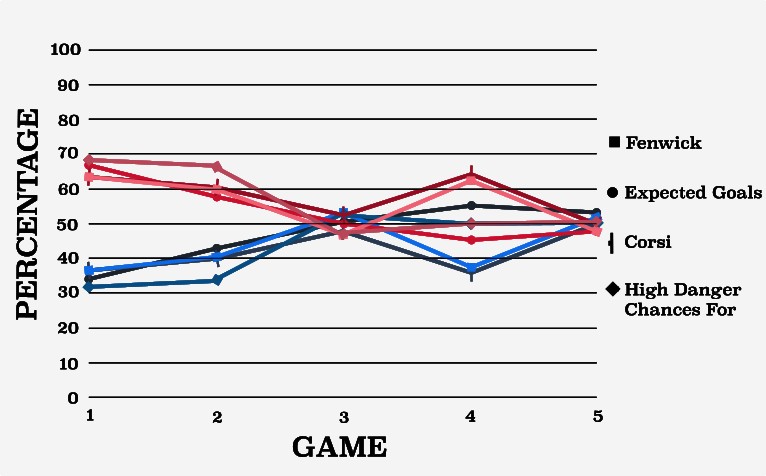
Analytically the Flames kept the series tight, often surpassing the Oilers in key statistics. Coach Daryl Sutter is known for defensively responsible 5-5 hockey, and that is exactly what the Flames produced. They led the Oilers in face-offs won, they out-shot the Oilers, they out-hit the Oilers, and the quality of their shots mostly matched that of their opponent’s.

A line graph depicting shot quality over the five game playoff series between the Calgary Flames (in red) and the Edmonton Oilers (blue). Fenwick, Expected goals, Corsi, and High Danger Chances For are advanced hockey stats that measure the likelihood a shot has of being a goal.

The difference came down to two players, arguably the most important members of their respective teams — Connor McDavid for Edmonton, and Jacob Markström for the Flames.

There were signs of things to come starting in the first game of the series, overshadowed by an eclectic game the Flames won 9-6. While Oilers coach Jay Woodcroft elected to yank goaltender Mike Smith out of his net six minutes into the first period, Sutter let Markström suffer six goals on 28 shots against in the eventual win.

Oilers forward Zack Hyman scored twice on Markström’s glove side, and the team would continue to target that weakness. The Oilers scored four glove-side goals in Game One, two in Game Two, two in Game Three, and three more in Game Five. Markström finished the series with a .850 save percentage, compared to Smith’s .907.

Connor McDavid, captain of the Oilers and league-leader in total points, also foreshadowed his imminent dominance with a skillful deke to open the scoring for Edmonton. He finished the series with 12 points, evidently scoring at will.

His series winning overtime goal was a shot from the slot through Markström’s glove.

Flames fans had a fairly stressful post-season, all things considered. In the first round they faced the Dallas Stars and notably goaltender Jake Oettinger. Over the course of the series, Oettinger made 268 saves — the third highest total ever during a playoff series.

Some frustrated fans went as far as to conduct Amharic curses in an attempt to get an edge over the net-minder.

At the tail-end of that series, Flames officials also elected to make tickets mandatory to attend the Red Lot event, a viewing party held outside of the Scotiabank Saddledome. Tickets for Game One of the Battle of Alberta became available at 9:00 a.m., May 18.

By 9:03 a.m., they were all gone.

“[There was] nothing. Sold out, like a big name concert,” said Takumi Matsuura, a local Flames fan.

“I was shocked.”

Matsuura is originally from Japan, and moved to Calgary to work as an automotive mechanic. According to him, he became interested in hockey when a friend brought him to a Flames game.

“I have a soccer team in my hometown, but I love [the] Flames more than them”, said Matsuura.

The event would eventually be cancelled due to high winds which caused significant damage to the area, and the Flames media team announced they were cancelling the following two Red Lot events.

They re-opened the event for game 4, and again, all 5000 available tickets were claimed nearly immediately.

Arthur Gallant was one of the fans who managed to get a ticket.

“This is a hockey city. It’s so exciting to be able to have a team that does well [and] we can all get behind it,” said Gallant.

“More importantly, after the pandemic — I don’t like crowds, but I love the sense of community.”

Another heartache for Flames fans came in the third period of the final game of the series. In a situation oh-so reminiscent of the 2004 Calgary-Tampa Bay final, the Flames were the victims of a controversial call when Blake Coleman had a goal disallowed due to a “distinct kicking motion”.

“When you look at it from above, the angle definitely changes like quite a lot,” says Kim Michelle-Brown, an Oilers fan and St-Albert resident.

“Whether I could say it was a full kicking motion? I don’t know.”

The call will be sure to sow discourse in many Alberta homes for decades to come.

While the end result was no doubt disappointing, Flames fan can take solace in a team that far exceeded expectations from the beginning of the regular season.

“Keep your chin up and your chests out and walk out proud,” said Sutter in his post-game press conference.

“Did a hell of a lot more than anybody said they’d do. I mean, the team that beat us was a favourite coming into the year and we weren’t even close.”

Calgary Flames fans look on from the Red Lot viewing party in Calgary as the Edmonton Oilers open the scoring.

Calgary to reconnect Inglewood Bird Sanctuary with Bow River

2–3 minutes
The site of the new Bow River channel inlet.

The city of Calgary is spending $6.7 million on the Inglewood Bird Sanctuary (IBS) reconnection project, citing the need to replace outdated infrastructure and to improve water quality within the lagoon.

The IBS, initially founded in 1929 by Selby Walker, is an abode for both city-dwelling and migratory birds — as well as other assorted wildlife. Since its inception, 270 species of birds and 21 species of mammals have been recorded in the urban park, according to the city.

The project will have three stages; stage one having begun in late March of this year. This first stage consists of digging out an inlet from the Bow River into the sanctuary, as well as reshaping gravel bars affected by the 2013 floods.

The city also plans to use bioengineering techniques to combat the erosion of the sanctuary’s river banks, using natural materials to create a self-sufficient system once properly established.

“[Bioengineering is] a technique that we’ve been using in the last nine years since the flood, in terms of including willows and plants and vegetation mixed in with rock and other material to stabilize the slopes,” says René Letourneau, a senior project engineer for the city of Calgary’s Water Resources and Infrastructure Delivery team.

“Over time the plants, the roots, [they] literally bind to either the rock or whatever material and actually get stronger over time.”

Stage one is currently on track to be completed in September, but as the construction is being done within a bird sanctuary, it will ultimately depend on the behaviour of the incumbent wildlife.

“Once the nesting season is over, which we expect to be late August, we will . . . resume some of that work where we can,” said Letourneau, “September is probably a good estimate that the IBS channel is complete or near complete”.

Stage two will see the installation of an art piece that doubles as a bridge over the newly constructed channel, the so-called “log jam” display designed by artist Tim Knowles.

Stage three will involve the replacement of the sanctuary’s hydraulic outlets, which were built over 100 years ago. These outlets will facilitate travel through the pond and eliminate fish traps and will also be used to control water levels within the lagoon.

“The project will also reduce the risk of the Bow river diverting to the sanctuary,” said Letourneau, “which if that were to happen it could harm the park; it could damage the Colonel Walker house and the lagoon itself.”

The full project is slated to be completed by September 2024, after which it will undergo a five-year monitoring period. The city expects the IBS to be fully operational during that time, although parts will remain fenced off to promote the establishment of vegetation and to protect the nesting sites of birds.

Centre for Suicide Prevention providing materials, training to Alberta pharmacies

2–3 minutes

The Centre for Suicide Prevention (CSP), a Calgary based organization with a focus in education, is now providing materials and START training to pharmacies in Alberta that request it.

According to the centre, pharmacists and their staff have the potential to play a crucial role in recognizing customers as suicidal, as well as how to approach them and how to assist them.

Akash Asif, the director of external relations for the CSP, spoke about how one of these interactions could look like.

“[It could be] someone is standing in front of the aisle and looking at a bottle of Tylenol, or other drugs there, and they don’t look like themselves — they look a little bit different or there’s some nervousness,” said Asif.

“[We want to] prepare people and equip them with the understanding of skills to be able to go and see and talk to them, let them know that [they’re] there for them.”

One of the CSP’s tools in achieving this goal is START training, an online training course provided by LivingWorks.

The course can be completed in less than two hours and focuses on recognizing when someone is thinking about suicide and connecting them to help and support.

“The first thing is understanding that anyone can be going through suicidal thoughts, or that anyone can consider suicide,” said Asif.

“It’s [about] recognizing the warning signs and mutations; knowing and paying attention to the people around you and understanding that there’s something different about them.”

Asif said these signs can present themselves in a variety of different manners, such as sporadic swings in mood or behaviour.

“START is really around paying attention, having [the] conversation, and then connecting that individual to the proper resources.”

Tasha Porttin, pharmacist and store manager of the Jasper Mettra Pharmacy, is one of the first participants of the CSP initiative.

Porttin says she first heard of the START training through the CSP and that most of her staff have completed the training.

“It’s great for people that aren’t necessarily healthcare workers . . . to have kind of a bit of basis around suicide prevention and knowledge on how to start that conversation with individuals”, said Porttin, “and just how to ask questions that maybe we’re not used to asking or maybe not comfortable with asking.”

Porttin also requested suicide prevention materials from the CSP, which now adorn her pharmacy.

The materials provided include assorted signage, pop-out shelf talkers, and take-away cards.

“Some people have expressed that that’s really refreshing to see,” said Porttin, “[and the staff are] really kind of grateful that it is up in the store [because] it just gives people the opportunity to know that this is a safe place.”

“I even had somebody, to be honest they were quite teary eyed, when they were thanking me for putting it up,” said Porttin.

“You could tell that that was a very touching thing for them to see.”

To those experiencing suicidal thoughts, the CSP recommends contacting Calgary’s Distress Centre. The centre has a 24-hour crisis phone line, and also provides counselling to those in need.

Okotoks receives FCM investment in order to boost asset management

2–3 minutes

The town of Okotoks will be receiving $49,680 from the Federation of Canadian Municipalities (FCM) in an effort to improve asset management capabilities. 

The town hopes to use this investment to integrate its Tangible Capital Asset data with its Geographic Information System (GIS).

Tangible Capital Assets are the significant economic resources managed by a community — such as road infrastructure, water management, and utility systems. GIS maps are used to help observe patterns and relationships, and to provide geological context.

 By merging the two, asset managers like Mark Styranka, a specialist hired by the town of Okotoks in 2018, can approach the data much more efficiently. 

“The goal is to formalize the process among all the assets in the town where we know the condition of all the assets possible,” said Styranka, and that that will help the town create “a magical formula to help decide [our] priorities”.

What Styranka hopes to do, in the simplest of terms, is to match up individual asset identifiers with the town’s available GIS maps. With over 30,000 individual assets available, that is no small task.

Styranka himself applied for the funding, and he said the town hopes to use that money to acquire an additional staff member.

“Roads are the big one left to do. If we did it ourselves it would take maybe two years,” said Styranka, “[now] we’ll hopefully have it done by the end of the year.”

Okotoks is one of 37 Alberta communities receiving an investment from the FCM in order to bolster asset management. Founded in 1901, the advocacy group receives funding from the federal government and in turn allocates it to municipalities across Canada.

“[Communities in Canada are] working to enhance their infrastructure and natural assets so they can continue to have sustainable and reliable services to improve residents’ quality of life,” said FCM president Joanne Vanderheyden in a February press release.

“Ensuring local governments have the right tools to make sound asset management decisions is one way we can help drive Canada’s economic recovery.”

Okotoks and the FCM have a long-standing relationship. In 2001, the town received support from the FCM’s Green Municipal Fund (GMF) in order to revamp its wastewater treatment facility by equipping it with a composting system. 

The result of this program was a 46 per cent reduction in gross per capita water consumption, and an estimated $63 million saved in water license purchases. In 2015, the project received an FCM Sustainable Communities award for the associated case study.

Okotoks again received this award in 2018 for its Living Soils filtration project, a bioretention stormwater management system. 

These initiatives are just two of the 120 GMF funded projects completed in Alberta thus far.

“I think sometimes Albertans get a bit of a rough ride because of being centered around oil,” said Styranka.

“Most people, especially in rural areas, are positive stewards of the land.”